11 February 2026
Out-of-Home (OOH) advertising has long been a powerful way to build brand awareness. From highways to city centers, traditional billboards have helped brands reach massive audiences.
But with digital transformation accelerating, a new format is redefining outdoor advertising: 3D anamorphic OOH.
So how does 3D anamorphic OOH vs regular OOH compare? And which one delivers better marketing results?
Let’s break it down.
What Is Regular OOH?
Regular OOH includes traditional outdoor advertising formats such as:
- Static billboards
- Lightbox displays
- Posters
- Standard LED screen ads
- Transit advertising
These formats focus on visibility and reach. The messaging is typically direct, bold, and easy to understand at a glance.
Regular OOH works well for:
- Brand awareness
- Promotions and offers
- Location-based campaigns
- Mass exposure strategies
What Is 3D Anamorphic OOH?
3D anamorphic OOH is a perspective-based animation technique designed specifically for large LED screens, often corner or curved billboards.
Using forced perspective and depth illusion, visuals appear to:
- Break out of the screen
- Extend into real space
- Interact with architectural elements
- Create hyper-realistic 3D effects
Instead of being just an advertisement, it becomes a spectacle that people stop to watch and record.
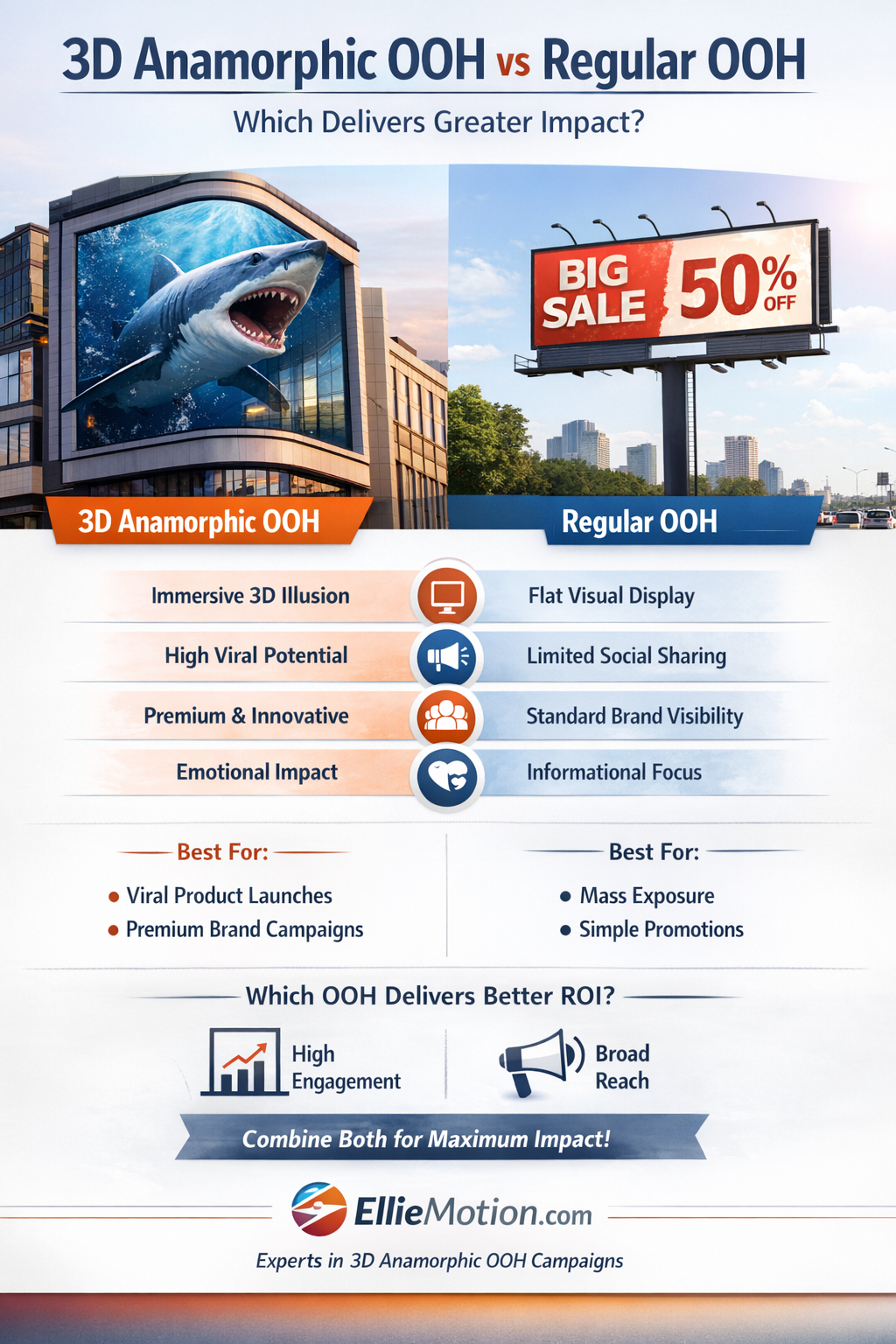
1. Attention-Grabbing Power
Regular OOH relies on bold design and placement. 3D anamorphic OOH disrupts visual patterns and creates a “wow” effect that demands attention.
In crowded urban areas, breaking visual monotony is critical and 3D illusion does exactly that.
2. Social Media Amplification
Traditional OOH exposure is mostly limited to physical viewers.
3D anamorphic OOH, however, often generates organic online reach because people naturally record and share impressive billboard illusions. This extends campaign visibility far beyond the physical location.
3. Brand Perception
Regular OOH signals presence and scale. 3D anamorphic OOH signals innovation, creativity, and premium positioning. Brands using this format are often perceived as forward-thinking and bold.
4. Cost vs Impact
Regular OOH:
- Lower production cost
- Easier execution
- Broad visibility
3D Anamorphic OOH:
- Higher production investment
- More technical precision required
- Greater impact and memorability
The right choice depends on your campaign objective and budget.
Elevate Your OOH Strategy
Choosing between regular and 3D anamorphic OOH doesn’t have to be difficult. The right creative approach can maximize both reach and impact.
Elliemotion specializes in high-impact 3D anamorphic OOH campaigns that turn billboards into unforgettable brand experiences. Let’s discuss and let’s build your next standout outdoor campaign.
When to Choose Regular OOH
- You need high-frequency exposure
- You’re promoting time-sensitive offers
- You want broad, simple brand visibility
- Budget is limited
When to Choose 3D Anamorphic OOH
- You’re launching a major product
- You want viral potential
- You’re targeting premium brand positioning
- You want to create a landmark-style campaign
Also read: 3D Anamorphic for OOH, Transforming Outdoor Advertising Into Immersive Experiences
Frequently Asked Questions (FAQs) About 3D Anamorphic OOH vs Regular OOH:
1. Is 3D anamorphic OOH always better than regular OOH?
Not always. It depends on your campaign objective. For mass exposure at lower cost, regular OOH may be sufficient.
2. Does 3D anamorphic OOH guarantee viral results?
No format guarantees virality, but the visual spectacle significantly increases shareability.
3. Which format has better ROI?
ROI depends on goals. Regular OOH offers steady exposure, while 3D anamorphic can deliver higher engagement and recall.
4. Can both formats be combined?
Yes. Many campaigns use regular OOH for coverage and 3D anamorphic OOH for high-impact flagship locations.
5. Is 3D anamorphic suitable for all industries?
Most industries can use it effectively, especially for product launches and brand-building campaigns.
Visit Us
Mactaggart Building, 42 Mactaggart Road,
#02-01E, Singapore 368086
Contact Us
© Elevate Future Labs Pte. Ltd. 2026